

- PASTORAL MESSAGE ON THE FEAST OF THE HOLY NATIVITY AND THEOPHANY

To the Reverend Fathers, Honorable Priests, Virtuous Religious Sisters, and All the Armenian Catholics of Armenia, Georgia, Russia, and Eastern Europe
Highly beloved brothers and sisters in Christ,
The Nativity of the Lord is truly a great and joyful tiding, which is nothing less than the proclamation of the reality of the divine mystery of the Incarnation of the Son of God to the hearing of the entire world—in defiance of a wicked and faithless human generation, and to the terror of the prince of this world. This ineffable divine reality—the Incarnation of the Son of God, His birth from a Virgin through supernatural intervention as the Gate of humanity’s salvation—took place and opened within a miserable earthly reality. At first glance, this is a confluence of contradictions: the highest, the uncontainable, the inaccessible manifest within the poorest, most wretched, grotesque, and incompatibly inferior reality; the Son of God in a tiny human body, the divine in an animal feeding trough as the Bread that grants eternal Life, which the beast perceived instinctively, yet man failed to perceive, as Saint Augustine explains.
But this contradiction is only apparent, because God operates within and through contradictions. Right there, where it seems impossible to await divine intervention, precisely there does the Gate of salvation open, and he who enters finds abundant sustenance to pasture upon; precisely there does the saving and sanctifying divine grace burst forth like a spring: “Where sin abounded, grace abounded much more” (Rom. 5:20). The prophet likewise announced the birth of a new hope from Bethlehem: “But you, Bethlehem, in the land of Judah, are not the least among the rulers of Judah; for out of you shall come a Ruler who will shepherd My people” (Mt. 2:6).
In this way, God shatters humanity’s hardened and insular patterns of thought, limited “realistic” logic, uncompromising syllogisms, and empirical forecasts. Where it is least expected, He opens the possibility of a new life, a new reality, a new perspective, and a new worldview (paradigm).
Consider the episodes of the promised names of John the Baptist and Jesus in the opening accounts of the Gospel of Luke, which illuminate the divine plan for opening this new reality. The angel says to Zechariah: “Do not be afraid, Zechariah, for your prayer is heard; and your wife Elizabeth will bear you a son, and you shall call his name John… But behold, you will be mute and not able to speak until the day these things take place, because you did not believe my words” (Lk. 1:13, 20). When John the Baptist was born, his relatives intended to call the child by his father’s name, Zechariah, according to ancient custom. Yet, the silenced Zechariah unexpectedly wrote down that the child’s name must be “John.” Thus God gave a new name, breaking tradition, because the event was unique and unrepeatable. The angel of the Lord gave the child a name that transcended all human-made paradigms; the angel gave a name to a new reality, forcing mankind to inevitably reckon with it.
In the same manner, the angel Gabriel appeared to Mary and delivered an even more extraordinary tiding: that she would conceive by the power of the Holy Spirit, and that she would name the child—not Joseph, according to custom—but Jesus. This was a name for a new, unprecedented, strange, and unexpected reality, which means: “The Lord Saves.” Joseph learned that something extraordinary had happened to Mary. Being a just man, yet acting as a child of the New Covenant, he sought to put her away quietly; but during the night, the angel said to him: “Do not be afraid to take to you Mary your wife, for that which is conceived in her is of the Holy Spirit” (Mt. 1:20).
Notice that the angel spoke to Zechariah, Mary, and Joseph precisely during their moments of fear and tension. Furthermore, he announced a miracle that was entirely unexpected to them. We all experience such moments of fear, tension, and uncertainty in our lives, and God provides strange signs; processes un-programmed by us unfold, we hear angelic voices, and we sense the interventions of the Holy Spirit, all heralding the dawn of a new reality.
The current days are likewise sorrowful within our Armenian reality; our nation and society are undergoing turbulent times. We hear frightening news, we live in a state of constriction and tension, and we appear as though we have lost our bearings. But be alert to hear the voice of the angel Gabriel; do not despise that voice! We are witnessing the mysterious, unexpected, and sometimes even unacceptable work of the Holy Spirit, which is visible in a faint but steadfast manner in the life of our nation and community—these are the glimmers of an awakening and a rebirth. We hear voices and see troubling images that rob our hearts of peace, but be careful not to misinterpret them. In the narrow minutes of our lives, God enters precisely through our wounds to shed light into our hearts—much like a surgeon who, in order to heal, cuts open the wound and inserts his hands to cure the person. In that same way, light enters our lives through our wounds. The process of healing is sometimes painful, sometimes incomprehensible and unexpected to us, but the result turns out to be just as unexpectedly good and saving for our souls as the beginning was unexpected and agonizing. Therefore, beloved, do not avoid listening to the whispers of God; though they may be terrifying at first, God does all this for our benefit.
The sign of the Savior’s birth was the appearance of a strange and unseen star in the Eastern sky, which the Magi interpreted as the sign of the manifestation of a new King—a King called the “Prince of Peace.” His birth and manifestation in Palestine brought turmoil to the hearts of Herod and his courtiers, who refused to accept the new reality. They refused to accept the will of God, which was proclaimed from the beginning in prophecy and came to fulfillment despite them, even at the cost of the slaughter of innocent babes and despite the grief of Rachel: “weeping for her children, and she would not be comforted” (Mt. 2:18).
Yet, that new, unexpected, and painful reality became true consolation for those to whom it was given to know and rejoice in the surprises of divine providence: the shepherds to whom the angels brought tidings, and the pagan Magi who, traversing a long journey from the East, came, found the Infant Jesus, and worshipped Him. Here, too, the chain of paradoxes continues: the Infant born in the poorest conditions is worshipped by shepherds—poor and simple folk, not nobles. The long-awaited Anointed One of Israel was not recognized or accepted by the people of Israel and Judah, nor by King Herod, but was recognized and worshipped by Gentiles from the distant East. God granted the grace of recognizing His Son to the poor and the Gentiles in an unexpected way. When the Lord Jesus began His preaching in Galilee and read the prophecy of Isaiah concerning Himself for the first time, He spoke precisely about this paradoxical truth, citing accounts from the Books of Kings—how Elijah was sent to a widow in Sidon outside of Israel, and how Elisha healed not an Israelite leper, but Naaman the Syrian. Hearing this paradoxical, unexpected truth, the elders of the synagogue sought to cast Jesus down headlong and kill Him, because it was unbearable to hear the naked truth in such a contradictory context and accept it.
For us Christians, the Nativity of Jesus—with its completely contradictory, real, and authentic image—is an occasion to humbly accept the divine truths revealed within contradictions as an opportunity for conversion and for adopting a new worldview. Indeed, how can one accept the crucifixion of the Son of God and His shameful death upon a Roman instrument of execution, if we do not first, with the humility of the shepherds and the Magi, accept and understand the Nativity of Jesus in a Bethlehem stable—the incarnation of the Son of God in a wretched human body? Or how can we comprehend the glorious Resurrection of the Lord, if we do not first understand that it is the very same Word of God who created the universe, who became man in a supernatural way from the Holy Virgin without violating her perpetual virginity, who raised the dead, and who rose Himself—passing through the furnace of human frailty, earthly injustice, human hatred, and envy, and “overcame the world”?
Therefore, beloved, the entire earthly life of our Lord Jesus Christ is a supernatural Mystery composed of contradictions and unexpected divine interventions; it is a hope born from the abyss of despair, a new life that opens in the desert of death, a sprout that grew amidst thorns and thistles to become for us the beginning of a new life, according to the words of the Apostle: “Therefore, if anyone is in Christ, he is a new creation; old things have passed away; behold, all things have become new” (2 Cor. 5:17).
The reality of our Ordinariate is also new. During the Jubilee Year of 2025, the Lord cultivated new shoots of Hope in our communities, particularly in the hearts of the youth who made a Pilgrimage of Hope to Rome—to the Petrine Holy See of the Catholic Church. They prayed in ancient sanctuaries, adored before the Holy Sacrament alongside His Holiness and millions of their peers, participated in the Holy Mass, and sensed the dynamism of the one, united, powerful, and holy Church, as well as their own Armenian identity within the bosom of that great Church. Our youth, and through their enthusiasm all our communities, are ever new in Christ Jesus. To the hopeless and faithless crowd, they are ever unpredictable, incomprehensible, and unexpected new creations, for whom there is always the possibility of a new life. For them, the door of holiness stands open, as does the opportunity to speak a new word for the Armenian nation and conquer new spiritual and moral heights.
Dear brothers and sisters, be assured of my profound love toward each of you and of my close, heartfelt communion with each one of you. Together, we can make our communities more unified, closer to God, and more deeply rooted in our national and spiritual identity. Together we can build a more loving, peace-loving, and just society—such as our Lord dreams to see, blessing us as a nation and as a valuable part of His Holy and unique Catholic Church. To achieve all this, we need the fervent spiritual life of each and every one of you. We can attain this if we are attentive and listen to the whispers of the Holy Spirit, His unutterable groanings of prayer on our behalf and for us, according to the words of the Apostle (cf. Rom. 8:26), and unfurl the sails of our ship toward the direction in which the divine wind blows, recalling the sacred calling of our baptism: “The wind blows where it wishes, and you hear the sound of it, but cannot tell where it comes from and where it goes. So is everyone who is born of the Spirit” (Jn. 3:8).
Christ is born and revealed!
Great tidings to you and us!
Gyumri, December 25, 2025
Feast of the Nativity of Our Lord Jesus Christ
✠ KEVORK NORADOUNGUIAN
Titular Archbishop of Sebastia
Ordinary of the Armenian Catholics of Armenia, Georgia, Russia, and Eastern Europe
 Armenian Catholic Youth Union Camp in Stepanavan
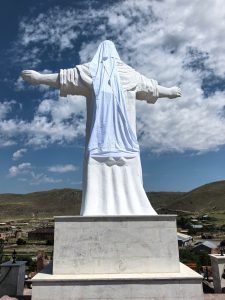 Consecration Ceremony օf the Statue Dedicated to the Lord Jesus in the Village of Dzitankov
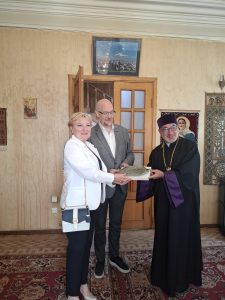 Visit of the Consul of Hungary to the Ordinariate in Gyumri
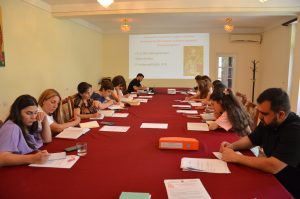 FIRST SPIRITUAL RETREAT FOR CATECHISTS HELD ON JULY 13-17, 2026
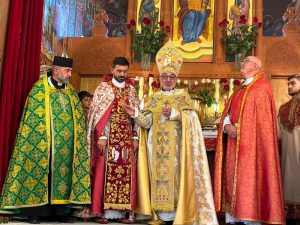 Pastoral Visits of the Ordinary to the Armenian Catholic Communities of Georgia
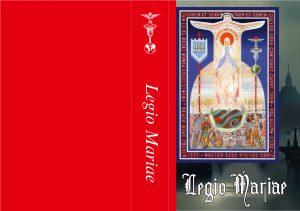 The Armenian Translation of the Official Handbook of the Legion of Mary Has Been Published
Օրացույց
