

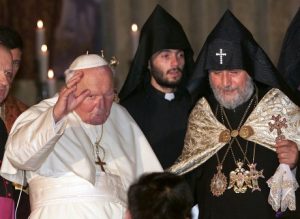
- Homily of St. John Paul II in the Cathedral of St. Gregory the Illuminator, Yerevan
APOSTOLIC VOYAGE IN ARMENIA
ECUMENICAL CELEBRATION
HOMILY OF JOHN PAUL II
Cathedral of St. Gregory the Illuminator
Yerevan, 26 September 2001“How good and how pleasant it is,
when brothers live in unity!” (Ps 133:1).
Praised be Jesus Christ!
Last Sunday Your Holiness and the entire Catholicosate of Etchmiadzin had the joy of
consecrating this new Cathedral of Saint Gregory the Illuminator, as a worthy memorial of
Armenia’s seventeen centuries of fidelity to our Lord and Saviour Jesus Christ. This splendid
Shrine bears witness to the faith handed down to you by your fathers, and it speaks to us all of
the hope which today inspires the Armenian people to look to the future with renewed trust and
courageous determination.
For me, to preside with Your Holiness at this Ecumenical Liturgy is a source of great personal
happiness. It is, as it were, the continuation of our common Prayer last year in Saint Peter’s
Basilica in Rome. There, together, we venerated the relic of Saint Gregory the Illuminator, and
today the Lord grants us to do so again here in Yerevan. I embrace Your Holiness with the
same fraternal affection with which you embraced me on your visit to Rome.
I am grateful to Your Excellency the President of the Republic for your presence at this
ecumenical meeting, a sign of our shared belief that the nation will thrive and prosper through
the mutual respect and cooperation of all its institutions. My thoughts turn to His Holiness Aram
I, the Catholicos of the Great House of Cilicia, and to the Armenian Patriarchs of Jerusalem and
Constantinople: I send them greetings in the love of the Lord. I warmly greet the distinguished
members of all the civic and religious bodies and communities represented here this evening.
When, through the preaching of Saint Gregory, King Tiridates III was converted, a new light
dawned in the long history of the Armenian people. The universality of the faith was wedded
inseparably to your national identity. The Christian faith rooted itself in a lasting way in this
land, gathered around Mount Ararat, and the word of the Gospel profoundly influenced the
language, family life, culture and art of the Armenian people.
While preserving and developing its own identity, the Armenian Church did not hesitate to
engage in dialogue with other Christian traditions and to draw on their spiritual and cultural
patrimony. At a very early stage, not only the Sacred Scriptures but the major works of the
Syriac, Greek and Latin Fathers as well were translated into Armenian. The Armenian liturgy
drew its inspiration from the liturgical traditions of the Church in the East and in the West.
Thanks to this remarkable openness of spirit, the Armenian Church throughout its history has
been particularly sensitive to the cause of Christian unity. Holy Patriarchs and Doctors such as
Saint Isaac the Great, Babghèn of Otmus, Zakary of Dzag, Nersès Šnorhali, Nersès of Lambron,
Stephen of Salmast, James of Julfa and others were renowned for their zeal for the unity of the
Church.
In his letter to the Byzantine Emperor, Nersès Šnorhali set out principles of ecumenical dialogue
which have lost none of their relevance. Among his many insights, he insists that the search for
unity is a task of the whole community, and it cannot be allowed to create internal divisions
within the Churches; he also teaches that there is a need for the healing of memories in order
to overcome past resentments and prejudices; that mutual respect and a sense of equality
between the spokesmen of the various Churches are indispensable; and finally he says that
Christians must have a profound interior conviction that unity is essential, not for strategic
advantage or political gain but for the sake of preaching the Gospel as Christ commands. The
insights of the great Armenian Doctor are the fruit of remarkable pastoral wisdom, and I make
them my own among you today.
“How good and how pleasant it is, when brothers live in unity” (Ps 133:1). When in 1970
Pope Paul VI and Catholicos Vazkèn I exchanged the kiss of peace, they launched a new era of
fraternal contacts between the Church of Rome and the Armenian Church. Their meeting was
soon followed by other important visits. I myself have very happy memories of the visits to
Rome of His Holiness Karekin I, first as Catholicos of the Great House of Cilicia, then as
Catholicos of Etchmiadzin. From the time he took part as an observer at the Second Vatican
Council, Catholicos Karekin I never ceased to work to promote friendly relations and practical
cooperation between Christians of East and West. I would have dearly loved to visit him here in
Armenia, but his ill health and untimely death made that impossible. I give thanks to the Lord
for having given us this great man of the Church, a wise and courageous champion of Christian
unity.
Your Holiness, I am truly happy to be able to return the visit which you made to me in Rome,
together with a delegation of Armenian Bishops and faithful. I saw your generous invitation to
visit Armenia and Holy Etchmiadzin as a great sign of friendship and ecclesial charity. For long
centuries contacts between the Armenian Apostolic Church and the Church of Rome were warm
and intense, and the desire for full unity never disappeared altogether. My visit today testifies
to our shared yearning to dwell in the full unity which the Lord wills for his disciples. We are
close to Mount Ararat, where tradition says that the Ark of Noah came to rest. Like the dove
returning with the olive branch of peace and love (cf. Gen 8:11), I pray that my visit will be a
kind of consecration of the already rich and fruitful cooperation existing between us.
There is a real and intimate unity between the Catholic Church and the Church of Armenia since
both preserve apostolic succession and have valid sacraments, particularly Baptism and the
Eucharist. Our awareness of this must inspire us to work even harder to strengthen our
ecumenical dialogue. In this dialogue of faith and love no question, no matter how difficult,
should be overlooked. Conscious of the relevance of the ministry of the Bishop of Rome in the
search for Christian unity, I have asked – in my Encyclical Letter Ut Unum Sint – that the
Bishops and theologians of our Churches reflect on “forms in which this ministry may
accomplish a service of love recognized by all concerned” (No. 95). The example of the first
centuries of the Church’s life can guide us in this discernment. My ardent prayer is for a renewal
of the “exchange of gifts” of which the Church of the first millennium gave such wonderful
examples. May the memory of the time when the Church “breathed with both lungs” spur
Christians of East and West to walk together in unity of faith and with respect for legitimate
diversity, accepting and sustaining each other as members of the one Body of Christ (cf. Novo
Millennio Ineunte, 48).
With one heart let us contemplate Christ who is our peace and who has brought about the
unity of what was divided (cf. Eph 2:14). Time is pressing, and ours is a sacred and urgent
task. We must proclaim the good news of salvation to the men and women of our time. Having
experienced the spiritual emptiness of communism and materialism, they are seeking the path
to life and happiness: they are thirsting for the Gospel. We have a great responsibility towards
them, and they expect from us a convincing witness of unity of faith and mutual love. As we
work for full communion, let us do together what we do not have to do separately. Let us work
together, with full respect for our distinctive identities and traditions. Never again Christians
against Christians, never again Church against Church! Rather, let us walk together, hand in
hand, so that the world of the Twenty-first Century and the new Millennium may believe!
The Armenian people have always had great veneration for the Cross of Christ. Down the
centuries the Cross has been their unfailing source of hope in times of trial and suffering. A
striking feature of this land are the many crosses in the form of the khatchkar, testifying to your
steadfast fidelity to the Christian faith. At this time of year, the Armenian Church celebrates one
of its great feasts: the Exaltation of the Holy Cross.
Lifted up from the earth on the wood of the Cross, Jesus Christ, our salvation, our life and our
resurrection, draws us all to himself (cf. Jn 12:32). O Cross of Christ, our true hope! Wherever
sin and human weakness have caused division, give us strength to forgive and be reconciled
with one another. O Cross of Christ, be our strength as we work to restore full communion
between all who look upon the Crucified Lord as our Saviour and our God. Amen.
I am grateful for your attention and I invoke God’s blessings upon our steps towards full unity!
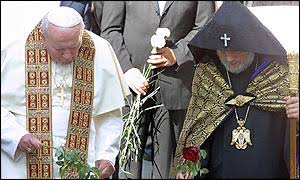 Farewell Speech of St. Joph Paul II in Zvartnotz Airport
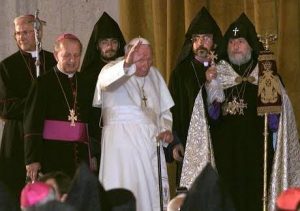 COMMON DECLARATION OF HIS HOLINESS JOHN PAUL II AND HIS HOLINESS KAREKIN II
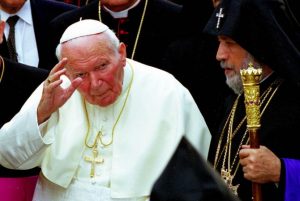 The Enchanting Paternal Homily of St. John Paul II for Armenian People in Etchmiadzin
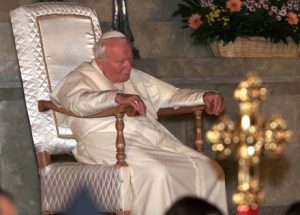 Address of St. John Paul II in Holy Etchmiadzin
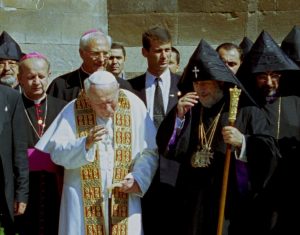 September 25, 2026, Marks the 25th Anniversary of Pope St. John Paul II's Visit to Armenia: an Unprecedented Historical Event
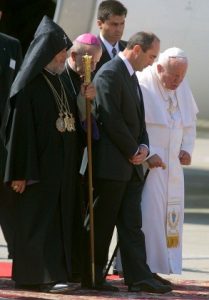 Address of St. John Paul II upon His Arrival into Zvartnots International Airport
Օրացույց