

- Conference of Leaders of Eastern Churches Dedicated to the 10th Anniversary of the Letter “Amoris Laetitia” Concludes

One of the clearest points of universal agreement among the leaders, he noted, was “the accelerating pace of change” affecting families, marriage, and associated customs in countries around the world over the past ten years.
On October 14, 2026, the Conference of Leaders of Eastern Churches, dedicated to the 10th anniversary of the Apostolic Exhortation “Amoris Laetitia” by His Holiness Pope Francis, concluded its work. As previously announced, His Excellency Archbishop Kevork Noradounguian also participated in the gathering alongside French-speaking bishops and experts in the capacity of an observer.
On the morning of October 14, the closing Holy Mass of the conference was celebrated in St. Peter’s Square in Rome. The Mass was presided over by His Eminence Cardinal Luis Antonio Tagle, Dean of the College of Cardinals, on behalf of His Holiness Pope Leo XIV, who was obliged to undergo emergency surgery on October 13 and is currently recovering. During the Holy Mass, Cardinal Tagle read the homily prepared by the Holy Father. At the beginning of the text, addressing the participants of the conference, the Pope stated:
“The joy of love experienced by families is also the joy of the Church” (Pope Francis, Apostolic Exhortation Amoris Laetitia, 19 March 2016, 1). With these words, ten years ago, Pope Francis began his Apostolic Exhortation Amoris Laetitia. Today, as we celebrate the Eucharist, we offer to the Lord the fruits of the work we have carried out on this document, and we seek to take its riches to heart and put its pastoral guidance into practice.
In the evening of the same day, a press conference was held to summarize the outcomes of the conference’s presentations and discussions. The speakers at the press conference were: Cardinal Luis Gerardo Cabrera Herrera, O.F.M., Archbishop of Guayaquil, Ecuador; Archbishop Charles Jude Scicluna, Archbishop of Malta; Reverend Professor Stanislaus Chu Ilo, Professor at DePaul University in Chicago; Reverend Father Giacomo Costa, S.J., consultor of the General Secretariat of the Synod, responsible for methodology; Reverend Father Philippe Bordeyne, Dean of the Pontifical John Paul II Theological Institute for Marriage and Family Sciences and coordinator of experts; as well as a married couple from Brazil, Solange Gregory Schila and Alisson Roberto Schila.
Reflecting on the Apostolic Exhortation published ten years ago, Archbishop Scicluna noted that Amoris laetitia “provoked an invitation to pastoral conversion, an attitude of listening to families before judging, and also discerning situations with an open heart.” He noted that The Joy of Love also fostered an attitude of “seeking the will of God, facilitating the encounter with God’s mercy, embracing people, finding them where they are, and leading them to meet Jesus as Saviour.” Archbishop Scicluna called this “the treasure” that Amoris laetitia brought to the Church, adding that ten years later it remains a fresh document that needs to be rediscovered. “I think that in a world which is being overtaken by robots and anonymity and solitude,” Archbishop Scicluna stressed, “the family has a prophetic role not only in society but for humanity’s future.”
Father Giacomo Costa described the atmosphere of the past days of discussions, which took place in spiritual closeness to the Pope following his surgery. The priest characterized the work of the meeting as intense and constructive, particularly regarding the exchange of different perspectives.
He noted that among the topics addressed was the importance of providing spiritual and practical support in situations of domestic violence and abuse, and recalled that participants insisted such assistance must be “timely” and pay particular attention to the protection of children and vulnerable people.
Participants, he said, also highlighted the need to reduce the stigma that can accompany seeking help in times of difficulty, and drew attention to the important role families ought to play in the formation of priests.
Father Costa then explained that the final part of the meeting was devoted to presenting the synthesis report, followed by discussions first in small groups and then in a plenary session. He observed that the report was recognized as a faithful reflection of the discussions, although some constructive observations were made to further emphasize its “missionary dimension.”
Cardinal Kevin Farrell, Prefect of the Dicastery for the Laity, the Family and Life, brought the meeting to a close by highlighting the importance of evaluating and receiving the teaching of Amoris laetitia.
One of the clearest points of universal agreement among the leaders, he noted, was “the accelerating pace of change” affecting families, marriage, and associated customs in countries around the world over the past ten years.
Discussions unfolded with the awareness that the Church is called to engage with human changes and developments, including matters of married life. This, he noted, requires a “clear-eyed view” of reality which, despite being challenged by ongoing transformations, remains animated by hope.
Drawing on the discussions held at the Vatican in recent days, Cardinal Luis Gerardo Cabrera Herrera identified four characteristics of family life: prayer, communion, formation, and mission.
The Cardinal Archbishop of Guayaquil emphasized that the common thread is accompaniment, which should be fostered not only in the settings where individuals carry out their work, but also for the benefit of the entire Church.
This thought was reflected in the testimonies of Solange Gregory Schila and Alisson Roberto Schila, who recounted how an attentive pastoral approach—not only to families’ vulnerabilities, but also to their resources and strengths—deepened their “sense of belonging to the Church” as a couple.
Asked how this work of accompaniment could be put into practice, Professor Chu Ilo offered several recommendations: “First of all, every parish and every diocese should have a marriage and family life ministry. The bishop from the Philippines told us about the mission stations. You know, sometimes people are waiting in the Church for people to come. But now it is the Church that goes to families, the Church that goes to the existential peripheries of life, rather than waiting for people to be in crisis and then come to the Church for a solution. It is a Church of accompaniment. And accompaniment,” he added, “requires working side by side with people at every stage of their lives. That is what Pope Leo asked of us at the beginning of this assembly.”
Fr. Hovsep Galstyan
Chancellor of the Armenian Catholic Ordinariate
October 15, 2026


 REPRESENTATIVES OF THE HOLY SEE AND THE ARMENIAN CATHOLIC ORDINARIATE PARTICIPATE IN THE COP-17 CONFERENCE
 182nd Anniversary of Tashir: a Celebration that Unites Us, Very Rev. Fr. Nerses Galstyan Speech
 H. E. Archbishop Kévork Noradounguian Participates in a Meeting of the Holy Father and Leaders of Eastern Churches in Rome, Dedicated to the Tenth Anniversary of Pope Francis’ Letter “Amoris Laetitia”
 Meeting with the New Directors of the Armenia Office of L'Œuvre d'Orient
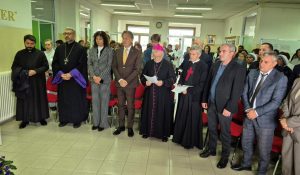 Hospital "Redemptoris Mater" of Ashotsk Celebrated Its 35th Anniversary
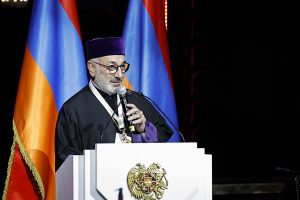 H. E. Archbishop Kevork Noradounguian Attended the 2026 "Prayer Breakfast" Event
Օրացույց