

- Canonical Conditions, Impediments, and Preparation for the Sacrament of Matrimony in the Armenian Catholic Church
Introduction
The Sacrament of Matrimony in the life of the Armenian Catholic Church is not simply a church ceremony. It is a Sacred Sacrament by which a man and a woman, through free and conscious consent, pledge mutual love, fidelity, and devotion for their entire lives, building their family life according to God’s presence and the teachings of the Church.
Therefore, the Sacrament of Matrimony cannot be celebrated solely based on the desire of the couple or by finding convenient conditions in any church. The Church has established specific canonical conditions, preliminary preparation, required documentation, examination, and verification of potential impediments in order to ensure the validity, licitness, and spiritual dignity of the marriage. Canon law explicitly requires that prior to the celebration of the Sacrament of Matrimony, it must be clear that there are no obstacles to its valid and licit performance.
These rules are not established to cause difficulties for the faithful or to distance them from the Sacrament of Matrimony. On the contrary, they are designed to protect the sanctity of marriage, the future family, and the rights of the marrying couple themselves.
Recently, however, situations have occurred where members of the Armenian Catholic faithful, unaware of the canonical requirements regarding the Sacrament of Matrimony, turn to another church—especially when they are unwilling or unable to complete the necessary preparation in their own parish.
There are also instances where circumstances arise placing the priest in a difficult position; yielding to the couple’s wishes, he may attempt to celebrate the Sacrament of Matrimony without the proper fulfillment of all necessary canonical requirements.
Here, a crucial principle must be emphasized: a priest’s personal desire or a couple’s request cannot replace the canonical order of the Church. If a canonical impediment exists, or if permission or a dispensation from the competent ecclesiastical authority is required, the matter must be resolved through the established procedure. According to the Canons of the Eastern Churches, in certain cases a priest cannot confer the Sacrament of Matrimony without the permission of the competent ecclesiastical authority.
Hence, it is essential that every Armenian Catholic believer knows in advance the conditions under which the Sacrament of Matrimony is administered, what preparation is required, what the possible impediments are, when it is necessary to apply to the ecclesiastical authority, and why one cannot simply move from one church to another to bypass canonical requirements.
In the near future, separate and explanatory materials will be presented on this subject, addressing point by point:
- Who can receive the Sacrament of Matrimony.
- What preliminary preparation is required.
- What examination and documents are necessary before Matrimony.
- What the canonical impediments to marriage are.
- In which cases permission or dispensation from ecclesiastical authority is necessary.
- What the canonical form of marriage means.
- Under what conditions an Armenian Catholic believer can be married in another church.
- Why one cannot move from one church to another to circumvent the preparation or canonical requirements set by the Church.
- What duties the priest, the couple, and the community have during the preparation for the Sacrament of Matrimony.
- What to do when a canonical obstacle or uncertainty arises.
The purpose of these clarifications is not to criticize anyone, but to inform, educate, and assist our faithful so that the Sacrament of Matrimony is administered in accordance with the requirements of the Church’s faith, canonical order, and sanctity.
Since the Sacrament of Matrimony is connected to a person’s whole life and the future of the family, a responsible approach toward it is not only an ecclesiastical duty, but also a manifestation of love and care for the future spouses and their family.
Dear faithful, if you have questions, need clarifications, or face specific situations regarding each point presented during this series, you can reach out to me. I will gladly and as clearly as possible answer your questions online as well.
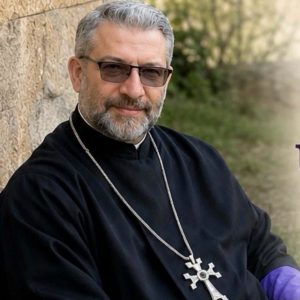
Fr. Nerses Galstyan
First Instance Judge for Canonical Issues of the Armenian Catholic Church in Armenia, Georgia, Russia, and Eastern Europe
Օրացույց