

- SYNODALITY: Walking Together Toward Holiness
Synodality as a Form of Christian Life and Ministry
When we speak of synodality, there is sometimes a danger of viewing it as merely one among many topics concerning the Church’s life today—an alternative form of pastoral methodology, community organization, or decision-making. In reality, synodality leads us much deeper, because it touches upon our way of being the Church and, above all, our way of being disciples of Christ.
The word itself helps us understand this: syn-hodós*—a path together. Synodality is the People of God walking together with Christ, led by the Holy Spirit, toward the Kingdom of God.
In this simple definition, we already find three fundamental questions: Who is walking? With whom are they walking? Where are they walking?
We do not walk alone. We do not choose the path on our own. And, most importantly, we are not the destination of the journey.
This is where I would like to begin, thinking in particular of you—the seminarians. For synodality is not something that will pertain only to your future ministry. It will not begin on the day you are ordained priests or when a community is entrusted to you. The way you learn to walk with others today prepares the way you will be able to serve them tomorrow.
Communion, Participation, Mission
Three words help us understand the synodal path: communion (community), participation, and mission.
Communion reminds us that the Church is not a collection of individuals. It is the People of God, the Body of Christ, communion in the Holy Spirit. This means that the diversity of vocations, ministries, cultures, sensibilities, and even temperaments should not be eliminated, but rather welcomed and harmonized within communion.
So the question is not simply how we can be together without having problems; the Christian question is more demanding: How can we belong to one Body while remaining different?
Participation is born from this communion. By virtue of baptism, every Christian participates in the life and mission of the Church. To be sure, not everyone does everything, and synodality does not eliminate the distinction of ministries and responsibilities. But it prevents anyone from thinking that they alone are the entire Church.
Regarding the Church’s Mission: The Church does not walk together to look at herself. The Church walks in order to be sent forth. Therefore, the ultimate question is not how capable we are of organizing ourselves, but how we can together proclaim Christ in today’s world.
Co-responsibility does not erase ministries; it places them in their truth. No one has everything, no one can do everything, but everyone has received something to put at the service of all.
Learning to Listen
If we were to draw a map of synodality, the first word would certainly be ‘listening’.
First of all, listening to God in prayer and in the Word. Without this primary listening, the ecclesial journey risks devolving into a mere clash of opinions.
Then, listening to the Church—to her living Tradition, her pastors, her communities, and the journey of those who have gone before us.
And listening to people: listening to their lives, their joys and struggles, their questions, and sometimes even their criticisms—not only those who are close to us or who think like us.
However, there is a crucial difference between hearing (perceiving with the sense of hearing) and listening (listening with understanding). We can hear someone while merely waiting for the moment to answer. Christian listening, on the other hand, seeks above all to understand.
For this reason, listening requires humility. One who truly listens accepts that the other person might show them something they do not yet see.
And it is precisely here that discernment begins.
To discern means to seek God’s will together. Not to impose our ideas or simply seek a compromise between different positions, but to ask ourselves: What is the Holy Spirit saying to the Church? What is the Holy Spirit asking of us here and now?
They listen, discern, decide, and then set out on the journey. Because discernment that does not lead to life remains incomplete.
Not Everyone Does Everything, but Everyone Has Something to Give
This becomes particularly important when we speak of vocations, ministries, and charisms. The Holy Spirit does not distribute all gifts to one person. He distributes them within the community so that they become a good for all.
That is why a Christian community grows not when one person can do everything, but when everyone is helped to discover the gift they have received and to put it into service.
Here lies one of the most concrete challenges for a future priest: “Will I be able to recognize the good that God is working without me? Will I be able to rejoice when someone else has a gift that I do not have? Will I be able to accompany them, form them, and allow them to grow?”
Authority and service exist precisely to serve communion. Christ Himself offers us the standard of Christian authority: “I am among you as one who serves.”
Therefore, authority in the Church is not power. It is responsibility. It means listening, discerning, deciding, accompanying, and also evaluating—making decisions when necessary, but always for the good of the community and the mission.
Christ washes the feet of the disciples and remains Teacher and Lord. Service does not weaken authority; it reveals which authority belongs to the Gospel.
Remaining in Communion Despite Differences
Walking together does not mean that everyone must think in the same way.
Perhaps one of the most genuine tests of synodality comes precisely when differences emerge. It is relatively easy to talk about communion when we agree; it is much more difficult to preserve it when opinions, sensibilities, or even wounds divide us.
For this reason, the synodal path requires dialogue, patience, humility, forgiveness, and reconciliation.
Ecclesial maturity is not the absence of conflicts, but the capacity to pass through them without letting them inevitably turn into division. This applies to the diocese, the parish, the family—and it also applies to the seminary. Formation in synodality does not happen through lectures on synodality alone. It happens by practically learning to live together, to listen to one another, to allow ourselves to be corrected, to ask for forgiveness, and to start anew.
Because the Church that walks together must also be formed together.
Having reached this point, however, we must ask ourselves these questions: Can we listen, can we discern, can we participate? Can we value charisms, share responsibilities, improve our structures, and learn to better manage differences and conflicts?
And is all of this sufficient? No.
Because synodality is not the ultimate destination of the Church.
The destination is holiness.
If we were to forget this, we would risk reducing synodality to a technique, an organizational model, or even a self-sufficient ecclesial ideal.
The Church walks together because she walks toward the One.
Holiness, on the other hand, is not an individual destination. It is the response to the love of God, who calls everyone by name; it is communion, because no one becomes holy alone; it is a path, because it is built every day through conversion and fidelity; and it is obedience to the Spirit, who transforms the heart and makes our life fruitful.
Then we can look at the saints not merely as models of virtue, but as the historical realization of the Church walking together. Their lives show us that holiness is possible when you listen, walk, serve, bear witness, and give birth to hope.
Three Witnesses, Three Questions
Now I would like to offer you not just three simple biographies, but three witnesses and three questions.
I have chosen three figures whom the Church has recently proposed for universal veneration through canonization: Saint Pier Giorgio Frassati, Saint Peter To Rot, and Saint Ignatius Maloyan. They are three very different figures in terms of origin, vocation, culture, and way of life, yet they allow us to see in practice how holiness can take on different faces and, at the same time, how no one becomes holy alone.
This choice also holds special meaning for me. Through my work, I had the opportunity to know and closely follow two of these canonization processes, and one of them touches us even more directly: Saint Ignatius Maloyan is a bishop and martyr of our Armenian Catholic Church. His canonization bequeaths to us not only a saint of the universal Church, but also a witness who belongs to our history, our ecclesial tradition, and the memory of our people.
I would not want, however, to simply relate their lives. Rather, I would prefer to let each of them ask us a question. For the saints do not belong only to the past; when we truly encounter them, they question our present and can shape our future.
Saint Pier Giorgio Frassati: “With Whom Am I Walking?”
The first question is very simple: With whom am I walking?
Pier Giorgio Frassati shows us a holiness rooted in relationships: friendship, fraternity, ecclesial belonging, prayer, and service to the poor.
His life reminds us that no one becomes a saint alone.
Holiness is born and grows within concrete relationships. We need people with whom we share our faith, who support us, who can also correct us, and who help us stand up and recognize God’s presence in our lives.
For a seminarian, this question is important today: Who are the people with whom I am learning to become holy? Am I able to recognize that even the brother who sometimes annoys me or puts me in a difficult situation can be part of the path through which God is shaping me?
Communion is not an addition to holiness; communion is one of the places or opportunities where holiness is born.
Saint Peter To Rot: “Am I Able to Recognize What God Is Doing in Others?”
The second question comes to us from Saint Peter To Rot: Am I able to recognize what God is doing in others?
Peter To Rot was a layman, a catechist, a husband, and a father. He had not received the grace of ordained ministry, but he had received gifts from God to put at the service of his community, and he was able to assume his responsibility in the life of the Church with courage.
His testimony forces us to take a fundamental conviction seriously: the Church grows when all the baptized discover and make fruitful their gifts.
And so, I would like to leave you with a very concrete challenge or encouragement: If you were to meet a Peter To Rot in your future parish, would you be able to allow him to grow?
Would you be able to recognize a layman with a true charism, to trust him, to educate him, and to entrust him with responsibility? Or might his ability seem like a threat to your authority?
True co-responsibility requires trust. Leaving room for others does not diminish the priestly ministry; on the contrary, it reveals its fruitfulness, because the priest is called not to replace the gifts of the Holy Spirit, but to recognize, guard, and help them grow.
Saint Ignatius Maloyan: “Do I Truly Belong to the People Entrusted to Me?”
The third question touches us even more directly: Do I truly belong to the people entrusted to me?
Saint Ignatius Maloyan, the bishop and martyr of our Church, was not merely a man placed at the head of a people’s leadership. He was a pastor who walked with his people, sharing their suffering and hope, and remaining faithful to them until the end.
Maloyan’s life reminds us that communion is not just a beautiful ecclesial word. It can have a cost…
A pastor belongs not only to himself. He does not view the community as a place to exercise an office. He learns to belong to the people entrusted to him, to know their history, their wounds, their faith, and their expectations.
For us Armenians, this testimony carries an even deeper strength. In Maloyan, fidelity to Christ, episcopal service, and belonging to his people coincide at the most difficult moment. He does not abandon his people, but shares their destiny to the end.
And so the question for each person can become very concrete: Will the people who will one day be entrusted to you be merely the location of your ministry, or will they become part of your life?
A priest can carry out many activities for a community without ever truly belonging to it. A pastor, on the contrary, walks with his people.
And it is precisely this belonging that makes the service of authority credible.
Mkhitar Sebastatsi: Precursor of Fidelity and Bright Witness of the Gospel
To these three saints, I would like to add one final figure: Mkhitar Sebastatsi, although he is not yet declared a saint by the Church. His cause for beatification is underway, and as the postulator who has the honor and responsibility of promoting it—and especially with the encouragement of His Excellency Bishop Noradoungouian—I consider it my duty to present him to you.
Naturally, this is a figure who is especially dear to me—not only because working on his cause for canonization allows me to draw closer and closer to his life, his writings, and his spiritual experience, but because I am convinced that Abbot Mkhitar still has much to say to our Church and, in particular, to you who are preparing to serve the Church of Christ.
After looking at Maloyan, bishop and martyr of our Church, with Mkhitar we also remain within our Armenian history, but we encounter another form of witness: not martyrdom of blood, but an entire life dedicated to fidelity to Christ, service to his people, and seeking a path of communion in the Church.
And perhaps it is precisely here that Mkhitar becomes especially significant for the topic we are addressing. In his experience, we find dimensions that are sometimes in danger of being opposed to one another: Armenian identity and openness, fidelity and renewal, belonging to one’s own people and the universality of the Church, communion and mission.
Mkhitar did not renounce his Armenian identity in order to open himself to Catholicism. On the contrary, it was the depth of his Armenian belonging that enabled him to give birth to encounter, culture, dialogue, and mission.
But at the center of all this was not a human project; it was Christ.
Mkhitar did not seek a new path first and foremost. He sought to follow Christ. And it is precisely by following Christ that he opened a path.
This is perhaps one of the most important lessons for us as well. We are not called primarily to invent new things endlessly. We are called to recognize where Christ goes before us, and to have the courage to follow Him.
For more than three centuries, the Church has continued to recognize the fruits of that path. And it is precisely this fruitfulness over time that reminds us: when a life is truly rooted in Christ, it can become a gift not only for its own time, but also for future generations whom that person will never see.
Synodality Begins Before Ministry
Let us return, then, to the point where we began.
All of this concerns not only what you will do one day as priests.
It is learned today—in relationships, in listening, in allowing oneself to be corrected, in recognizing the gift of the other, in not always being the one who has the final word. We cannot imagine that one day we will be priests who know how to listen if we do not learn to listen today. We will not be pastors who build communion if we do not learn to live in communion today. We will not be able to value the gifts of the People of God if today we find it difficult to recognize the gifts of the brother walking beside us.
The way we learn to walk with others today prepares the way we will be able to serve them tomorrow.
And perhaps here we can summarize the three questions that accompanied us:
With whom am I walking?
Am I able to recognize what God is doing in others?
Do I truly belong to the people entrusted to me?
These are questions about synodality, to be sure. But ultimately, they are questions about the very form of ministry.
The priest is called not to lead the people to himself, but to walk with the people toward Christ. For this reason, we could summarize everything in a very simple expression:
Do not be the center, but point to the Center!
Walk with others without choosing only those who are like us. Recognize what God is doing in others without feeling threatened by their gifts. Belong to the people entrusted to you without considering them merely as the recipients of our ministry.
This is the evangelical logic of ministry: “Whoever wants to become great among you must be your servant, and whoever wants to be first must be slave of all” (Mark 10:43–44).
The Destination is Holiness
In the end, then, we return to the decisive word.
Synodality is not simply a method of the Church. It is an ecclesial style of listening, communion, and co-responsibility, where each person helps the other to recognize and follow Christ.
But the destination is holiness. And the path is walking together.
Not simply together for the sake of being together. Not together so that it will be easier. Not together so that everyone thinks the same way.
Together toward Christ.
Christ is the One who calls us, He is the One who goes before us, He is the One who gives meaning to the journey.
And perhaps this is the simplest and deepest form of Christian synodality:
No one walks alone, no one becomes holy alone.
We walk together, toward Christ.
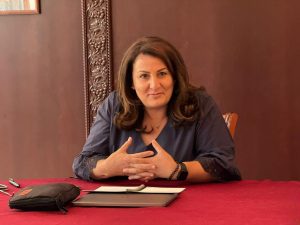
Dr. Valentina Karakhanian
Researcher-Archivist at the Historical Archives of the Dicastery for Evangelization (“Propaganda Fide”) at the Holy See and Postulator for the Causes of Saints
Erevan, September 3, 2026
Օրացույց