


-

CHILDREN AND VULNERABLE ADULTS SAFEGUARDING POLICY
(Including also all youth centers)
Protection from Abuse and Exploitation
TABLE OF CONTENTS
- PURPOSE
- GLOSSARY OF TERMS
- PROTECTING CHILDREN AND VULNERABLE ADULTS
- PREVENTION
- RESPONSIBILITY TO REPORT
- COMPLAINTS AND COMPLAINANTS
6.1 Receiving a complaint
6.2 Processing the complaint
6.3 Investigation procedure
6.4 Communicating outcomes
6.5 Appeals procedure
6.6 Confidentiality
- DATA PROTECTION
- ANNEXES
Annex I – Standards of Behavior Towards Children and Vulnerable Adults
Annex II – Report Form
- PURPOSE
The Ordinariate of the Armenian Catholic Church in Armenia, Georgia, Russia, Ukraine and Eastern Europe has a commitment to protect the safety and dignity of every person. Therefore, the safeguarding and promotion of the welfare of children and vulnerable adults are of crucial importance. The Ordinariate is determined to do the same for every staff member, volunteer or collaborator who carries out its work.
This Safeguarding policy is intended to set out the guiding principles and values applicable to all institutions and elements of the Ordinariate. These guiding principles and values need to be implemented through the relevant regional and local policies and procedures.
Ordinariate recognizes the rights of children and vulnerable adults to protection, regardless of their gender, race, ethnic origin, culture, disability or other similar grounds.
Ordinariate is committed to creating and maintaining an environment, which promotes its core values and prevents abuse and exploitation of all people. Ordinariate staff and associates are expected to uphold the dignity of all people with whom they come into contact by ensuring that their personal and professional conduct is of the highest standards at all times. They are equally expected to serve with integrity and promote the right relationships while taking their responsibilities.
- GLOSSARY OF TERMS
Child – any person under the age of 18;
Vulnerable Adult – individuals aged 18 years and over who are at greater risk of significant harm due to factors such as gender, age, mental or physical health, or as a result of poverty, inequality or experience of displacement or crisis;
Staff – all staff members, volunteers, interns and governance members;
Associates – All consultants and contractors;
Safeguarding – the responsibility that organizations have to make sure their staff and programs promote the welfare of children and vulnerable adults and do not expose them to the risk of harm and abuse;
Protection – the responsibility and measures taken to prevent and respond to abuse and exploitation of a child or vulnerable adult. This includes building awareness, promoting training, identifying and responding to all complaints, monitoring and evaluating protection structures, and taking personal responsibility.
Child protection – preventing and responding to violence, exploitation and abuse against children, including sexual exploitation and abuse, trafficking, child labor and harmful traditional practices.
Abuse – any action or inaction that causes harm to another person. It can include physical abuse, emotional abuse, sexual abuse and neglect. It also includes abuse online and/or through mobile technology. There are various types of abuse including:
– Sexual abuse: Any actual or threatened sexual act of violence perpetrated against a child or adult, whether by force or under unequal or coercive conditions. Examples of sexual abuse include rape, abusive sexual contact like unwanted touching and non-contact sexual abuse such as sexting and verbal or behavioral sexual harassment, as well as having any sexual intercourse without violence with a child under the age of 16.
– Physical abuse: The actual or likely physical injury to a child or adult, such as hitting, kicking, shaking, etc. which was intentionally inflicted or knowingly not prevented.
– Emotional abuse: Harm done by persistent or severe emotional ill-treatment or rejection, such as degrading punishments, threats, bullying, and not giving care and affection.
– Neglect: When basic needs such as food, warmth and medical care are not met, or when there is a failure to prevent exposure to any kind of dangers.
- PROTECTING CHILDREN AND VULNERABLE ADULTS
The Ordinariate prohibits all forms of exploitation and abuse, namely:
– Ordinariate clergy, staff and associates are prohibited from engaging in sexual activity with children and vulnerable adults. Mistaken belief regarding the age of a child is not a defense.
– Ordinariate clergy, staff and associates are prohibited from causing any physical or emotional harm to children or vulnerable adults.
– Ordinariate clergy, staff and associates are prohibited from offering money, employment, goods, or services for sex, including sexual favors from children and vulnerable adults.
– Ordinariate clergy, staff and associates are prohibited from any form of humiliating, degrading, or exploitative behavior toward children and vulnerable adults.
– Ordinariate clergy, staff and associates are not to use their power or position to withhold assistance or services, or to give preferential treatment.
– Ordinariate clergy, staff and associates are prohibited from using their power or position to request or demand payment, privilege, or any other benefit from children and vulnerable adults.
-Ordinariate clergy, staff and associates are prohibited from engaging in trafficking of human beings, in all forms.
In the same spirit, Ordinariate clergy, staff and associates are strictly prohibited to engage in sexual relationships with beneficiaries since they are based on inherently unequal power dynamics. Such relationships are contrary to the Ordinariate principles and values and undermine the credibility and integrity of its mission and work.
Clergy, staff members and volunteers working with children and vulnerable adults have undergone preventative training courses provided by authorized organization.
- PREVENTION
Ordinariate is adhering to the highest human resource and recruitment standards to safeguard people we work with against exploitation and abuse. This includes:
– Safe recruitment – referencing and vetting prospective applicants with emphasis on impeccable record of accomplishment in carrying out their work in conformity with the Internal Rules and Regulations, Code of Conduct and Children and Vulnerable Adults Safeguarding Policy. All staff of projects and those who directly work with vulnerable adults are requested to present a Certificate of Conviction alongside with other documents.
– Induction – clergy and all staff have completed an induction on Ordinariate Internal Rules and Regulations, Code of Conduct, Child and Vulnerable Adults Safeguarding Policy and Complaint Handling Procedures, and other related documents.
– Acknowledgment – clergy and whole staff have read, understood and admitted the Child and Vulnerable Adults Safeguarding Policy while signing the Contract with Ordinariate.
- RESPONSIBILITY TO REPORT
Ordinariate clergy, staff and associates are obliged to report any concern or suspicion of exploitation and abuse of a child or vulnerable adult. Failure to report may put the victim and Ordinariate at risk and is a breach of this Safeguarding Policy and of the Code of Conduct.
- COMPLAINTS AND COMPLAINANTS
The Ordinariate has zero tolerance towards violence, abuse, harassment and exploitation, and supports anyone who wishes to report and complain about misconduct and bad behaviour.
Complaints will be thoroughly investigated in cooperation with ecclesiastical and (or) civil authorities and in accordance with relevant laws, regulations and procedures, and decisive actions will be taken.
6.1 Receiving a complaint
Formal complaints should be presented, using the Report Form , in writing, on a hard copy or via e-mail directly to the Ordinary of the Armenian Catholic Church in Armenia and Eastern Europe. Clergy and staff should be aware of the possibility of referring the Ordinary in this regard. The complainant will receive notice of receipt of the complaint within two working days. Informal complaints are also handled by the Ordinary. Children/guardians/vulnerable adults are informed about the possible ways of the complaint.
VERBAL – child/guardian/vulnerable adult expresses a verbal complaint to the staff member or priest he/she trusts the most; children/vulnerable adults with speech and language impairments have a right to use the alternative communication means for applying to the trusted staff member or priest.
WRITTEN – child/guardian/vulnerable adult expresses a complaint in written form; chooses the addressee of the letter he/she trusts the most. Written form complaints may be expressed anonymously as well.
Upon receiving a complaint from child/guardian/vulnerable adult Ordinariate clergy, staff and associates are obliged to inform (verbally or using the Report Form) the Ordinary (in case of the reasonable complaint).
All people that receive the complaint are bound to secrecy and will only disclose information about it to the relevant person in charge to take action, if any.
6.2 Processing the complaint
The Ordinary preliminarily assesses the type and nature of the complaint and recommends the most appropriate course of action to be undertaken. For minor complaints, the Ordinary can take a decision on their processing alone. The seriousness of the complaint determines how the investigation should be conducted. The Ordinary may create the Complaints Handling Committee (CHC) (Temporary acting committee). It is followed by the strict rule of confidentiality and a need-to-know basis. The members of CHC are provided with only the essentials of the complaint. Major and more sensitive complaints will be dealt with CHC.
The CHC may be composed of:
- The Ordinary;
- One of the Priests;
- Members of the Ecclesiastical Tribunal – one of the Judges, the Defender of the Justice, the Defender of the Bond;
- Additional persons if doomed needed.
The possible conflict of interests should be considered before the appointment of the CHC members, and if any of the members of the CHC has the conflict of interest in the complaint after his/her appointment, he/she will be replaced.
6.3 Investigation procedure
The Ordinary has the primary responsibility to coordinate the investigation. Investigations are carried out confidentially and only persons that need to know about the complaint are involved in the process. During investigating complex and serious complaints external qualified experts should be invited.
The Ordinary identify the most qualified expert based on the nature of the complaint, geographic location and language requirements. Timeframes for completing the investigation vary depending on their complexity.
6.4 Communicating outcomes
The Ordinary provides feedback to the complainant and those involved in the complaint as appropriate. In case of a sensitive complaint, the complainant, unless he/she is at the same time the victim, has no “right” to know the outcome of the investigation. The Ordinary provides the complainant with the information on whether the complaint has been substantiated or that the complaint is not substantiated. No other information or detail will be disclosed.
6.5 Appeals procedure
Ordinariate wishes that any complaint be resolved in a satisfactory fashion for both the complainant and the organization. If the complainant does not feel satisfied with the outcome, he/she can appeal to the Responsible for Safeguarding Policy. This can be done in writing, by e-mail to the following E-mail address: [email protected]; or by hard copy letter to the office of the Ordinariate with the following addresses: Atarbekyan str. 82, 3104, Gyumri, Armenia, Tbilisyan highway 1/3, 0052, Yerevan, Armenia.
Confidentiality
All complaints will be handled in a confidential manner. In some cases, it may be necessary to disclose information to third parties. This will be decided on a case-by-case basis and, as far as possible, with the agreement of the complainant. Confidentiality is paramount to guarantee safety to complainants, whistle blower, witnesses and subjects of complaints. Information about the complaints and related investigations should only be shared on a need-to-know basis, clearly identified for each case. In case of breach of confidentiality, Ordinariate may take disciplinary action, except when:
– Disclosure is required by law;
– Disclosure is required by the Ordinary in the best interest of all parties involved;
– Disclosure is needed in order to obtain specific expertise (medical, legal, other).
Complaints that indicate a possible criminal offence should be immediately referred by the Ordinariate to legal authorities responsible for investigating such matters.
- DATA PROTECTION
Ordinariate is committed to apply the highest levels of protection in the processing of personal data. Personal information acquired during investigations related to the breach of the Ordinariate Code of Conduct and the Ordinariate Child and Vulnerable Adults Safeguarding policy will be treated in accordance with the Law of Armenia (Georgia, Russia depending on the location of the issue) on “Personal Data Protection”.
- ANNEXES
The following Annexes are attached to the present document, forming an integral part of the Children and Vulnerable Adults Safeguarding Policy.
Annex I – Standards of Behavior Towards Children and Vulnerable adults;
Annex II – Report Form.
ANNEX I – STANDARDS OF BEHAVIOR TOWARDS CHILDREN AND VULNERABLE ADULTS
Ordinariate must remain aware of perceptions and appearances in their language, actions, and relationships to children and vulnerable adults and safeguard them from harm. Ordinariate staff and associates should be aware at all times to uphold the dignity of each child and vulnerable adult and treat them with respect.
The following outline provides behavioral expectations of all Staff and Associates when interacting with children and vulnerable adults.
Ordinariate Staff and Associates:
MUST
Conduct themselves in manner consistent with values of Ordinariate;
Treat all children/vulnerable adults despite their gender, race, language, religious, national, ethnic and social background;
Listen to children and vulnerable adults;
Provide welcoming, inclusive and safe environment for children and vulnerable adults that prevents all forms of abuse and exploitation;
Be sensitive when they are around children/vulnerable adults (i.e. language, conversations, touch, gestures);
Be transparent in actions and whereabouts;
Have at least one other adult present when they are with a child. Care and discretion must be used on all one-on-one situations;
Ensure that the contacts with children are supervised, accompanied or at least take place in sight of other adults;
Ensure that an adult caretaker is present when transporting a child; and if not possible, obtain appropriate permission;
Report any concerns of child/vulnerable adult abuse or exploitation;
Disclose all charges or convictions if they relate to child/vulnerable adult exploitation;
Comply with Armenian legislation.
MUST NOT
Hit and physically abuse children/vulnerable adult, Physical punishment;
Emotionally or verbally abuse a child/vulnerable adult;
Be harsh toward a child/vulnerable adult;
Use of a “hate speech”;
Have sex or engage in any sexual activity with a child/vulnerable adult including inappropriate touch;
Send degrading or harmful written or verbal messages to a child/vulnerable adult;
Use any computers, mobiles, video cameras or social media to exploit or harass children/vulnerable adults;
Hiring a child’s labor, disregarding the best interests of a child and active State Legislation;
Taking advantage of child/vulnerable adult’s physical and intellectual potential for personal purposes;
Encourage a child to meet with them outside of work-related activities;
Take a child/vulnerable adult to their own homes, and personal visits to their homes are prohibited.
Find themselves alone with a child (exception with consideration of a need to realize a professional activity);
Show favoritism;
Be intoxicated or under the influence of drugs when with children/vulnerable adults;
Subjecting a child/vulnerable adult to any propaganda to control him/her.
ANNEX II – REPORT FORM
SUSPICION OF ABUSE OR EXPLOITATION OF A CHILD OR VULNERABLE ADULT
Instructions
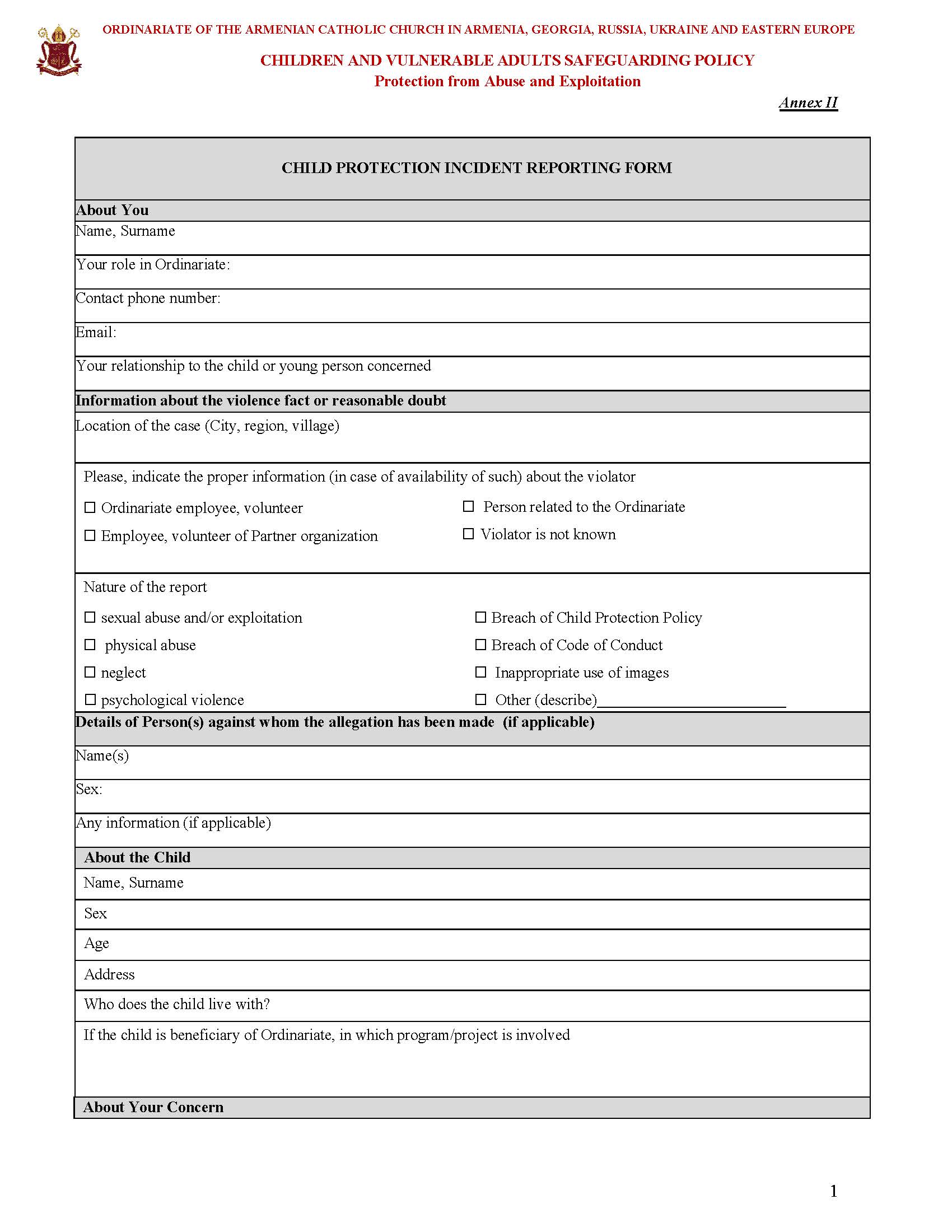
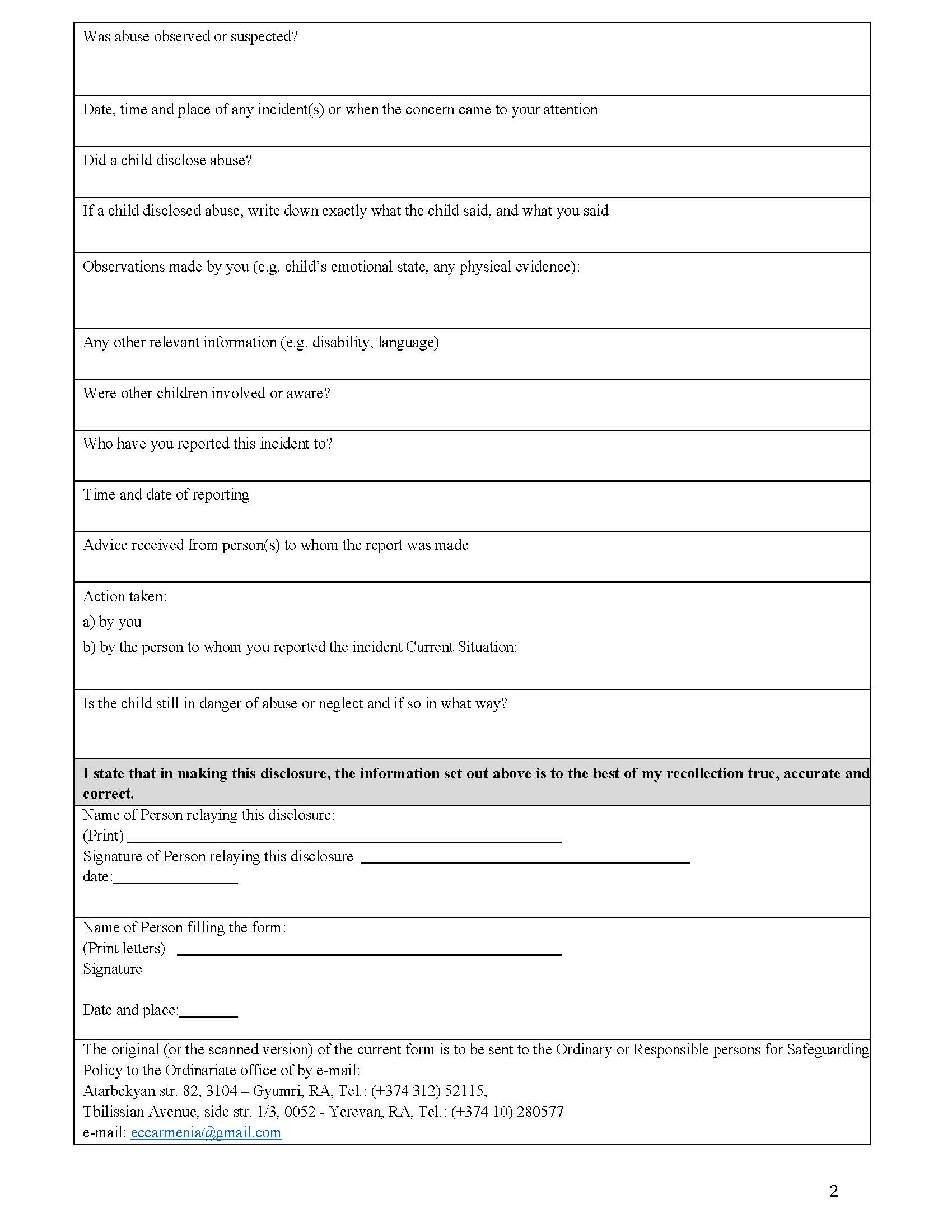
Any suspicion or concern of abuse or exploitation of a child/vulnerable adult involving Ordinariate staff and associates must be reported as required in the Ordinariate Children and Vulnerable Adults Safeguarding Policy. If you are unable to complete all of the sections of the Report Form, fill in what you do know. If there is more than one victim, please complete a separate report for each victim. The reporter’s identity will not be disclosed except on a “need-to-know” basis. If the reporter believes danger is imminent to themselves or anyone involved, he/she should alert the Ordinary.
Ordinariate is committed to addressing and responding to all reports.
The purpose of this Report Form is to report any suspicious activity of abuse or exploitation for Ordinariate to assess and determine next course.
A sample of the Report Form is presented here below.
The Report Form is also available as a separate file as:
PDF Annex II Child Protection Incident Reporting Form;
and can be obtained from the Ordinariate office or downloaded from the official website of the Ordinariate: https://armenianchurchco.com/.
PDF of the “CHILDREN AND VULNERABLE ADULTS SAFEGUARDING POLICY”: Safeguarding Policy English
Confirmed on 19 August, 2026
Gyumri, Armenian Catholic Ordinariate office
✠ Most Rev. KEVORK NORADOUNGUIAN
Titular Archbishop of Sebastia,
Ordinary of the Armenian Catholics of Armenia, Georgia, Russia
and Eastern Europe
Օրացույց